


From Import Dependence to Engineering Confidence: The Rise of China’s Large-Scale Aquarium Acrylic Industry(一)


For many years, the world’s most demanding public aquarium projects were associated with a relatively small group of international acrylic manufacturers and specialist engineering companies.
Large viewing windows, deep-water tunnels, giant cylinders and ultra-thick transparent structures required more than ordinary PMMA sheets. They required a combination of material science, structural engineering, casting technology, bonding control, annealing, machining, logistics and on-site installation.
A decade or more ago, many of China’s most challenging large-aquarium projects still relied heavily on imported acrylic technology, foreign brands, or internationally controlled production systems. The situation today is very different. China is no longer simply consuming large-scale aquarium acrylic technology.
It is increasingly designing, manufacturing, engineering and delivering some of the most complex transparent water-retaining structures itself. And the significance of this shift goes far beyond cost. It represents the emergence of a new generation of Chinese engineering companies capable of addressing structural safety, optical continuity and long-term operational stability at very large scale. Among them is Lanhu Acrylic.
Thick Acrylic Is Not the Real Breakthrough
When people discuss the development of China’s acrylic industry, they often focus on one number: thickness.
How thick can the panel be?
00 mm?
500 mm?
800 mm?
That is an understandable question, but it misses the deeper point.
The ability to cast an ultra-thick acrylic block is only one part of the technology chain. For large aquariums, the real engineering challenge begins after the material is produced.
The project team must still solve:
long-term hydrostatic loading;
allowable stress and deformation;
creep behavior;
bonding interfaces;
panel segmentation;
optical distortion;
residual stress;
annealing;
machining tolerances;
steel and concrete interfaces;
waterproofing;
transportation;
lifting;
installation;
future inspection and maintenance.
In other words: A thick acrylic panel is a product. A safe large aquarium is an engineering system. This distinction is becoming increasingly important as Chinese companies move from material supply into full-scale project delivery.
Why Large Aquariums Became a Test of China’s Manufacturing Maturity
Public aquariums are an unusually demanding application for acrylic. The material must remain transparent while continuously retaining enormous water loads. It must perform not for hours or months, but for years.
It must tolerate the realities of construction tolerances, temperature variation, chemical exposure, maintenance and biological operation. At the same time, visitors expect the structure to appear almost invisible. The better the engineering, the less of it the visitor notices.
That creates a difficult paradox: the structure must be extremely strong, while visually appearing almost absent.For many years, this combination of engineering reliability and optical quality gave established international suppliers a strong advantage. But the Chinese market itself became a powerful training ground.
China built:
large public aquariums;
marine parks;
commercial aquarium attractions;
underwater tunnels;
giant cylinders;
transparent swimming pools;
increasingly ambitious mixed-use water features.
Each project increased local experience in design, fabrication, bonding, transport and installation.
The result is that Chinese acrylic engineering today is no longer competing only on manufacturing cost.
It is increasingly competing on technical integration and project execution.
Tonglu Service Area: A Case That Shows How Far the Industry Has Moved
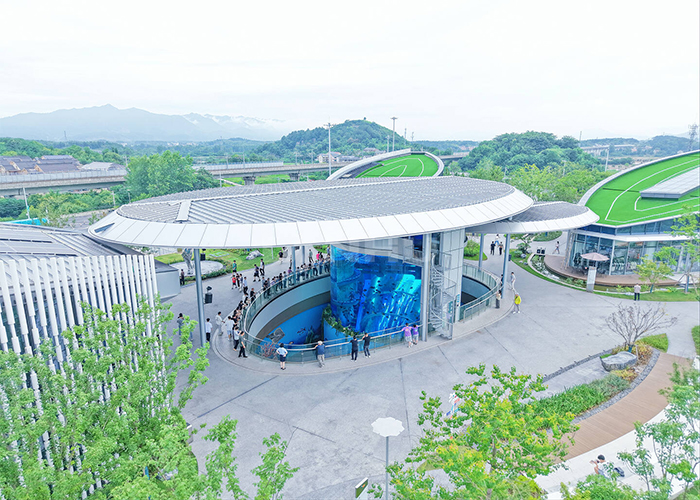
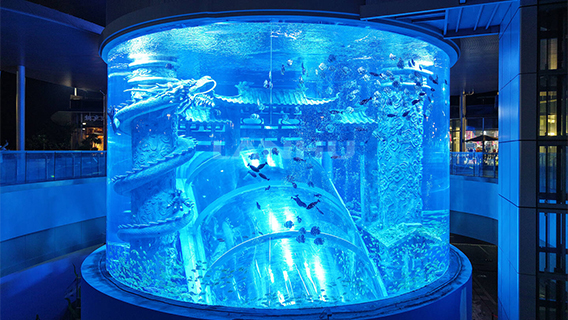
One project illustrates this transition particularly well. At the Tonglu Service Area on the G25 Changshen Expressway in Zhejiang, China, a giant cylindrical aquarium has transformed an ordinary highway stop into a widely recognized visitor attraction.
Public media reports describe the aquarium as approximately 14 meters high with an internal diameter of 13 meters, holding roughly 900 tonnes of water. The attraction also includes an underwater tunnel and has become a highly visible part of the service area's transformation into a leisure and tourism destination.
Lanhu Acrylic’s own project information identifies the installation as a major cylindrical acrylic aquarium project and states that the system uses very thick acrylic components engineered for large aquatic environments.
The significance of the Tonglu project is not simply its size. Its importance lies in the number of engineering problems that had to be solved simultaneously. A giant cylinder is much harder than a giant flat window;
Flat aquarium windows are already demanding.
A giant cylinder introduces additional complexity.
The structure must maintain:
circular geometry;
uniform load dist
ribution;
controlled deformation;
consistent curvature;
highly accurate bonding interfaces;
visual continuity around the entire viewing surface.
At Tonglu, the challenge was increased further by the integration of visitor circulation and tunnel elements at the base of the structure.
This meant the aquarium could not be treated as an isolated acrylic vessel.
It had to be coordinated with:
architectural circulation;
structural supports;
tunnel geometry;
waterproofing;
mechanical systems;
life support systems;
landscape elements;
long-term maintenance access.
This type of project demonstrates why large aquarium engineering has moved far beyond simple acrylic fabrication.
The Hidden Difficulty: Bonding Massive Acrylic Components
Visitors see a continuous transparent cylinder. Engineers see something very different. They see interfaces.
Every large acrylic project eventually depends on how individual components are joined together.
At very large scale, bonding becomes one of the most critical technical stages because the joint must simultaneously provide:
structural continuity;
optical clarity;
dimensional accuracy;
low residual stress;
long-term reliability;
resistance to defects created during curing and installation.
A poor joint may look acceptable when empty. The true test begins after the aquarium is filled.
Water pressure, temperature variation and long-term material behavior begin acting on the structure continuously. That is why the quality of a giant aquarium cannot be judged only by the thickness of the acrylic. It must be judged by the quality of the entire engineering chain. From Material Production to BIM and Multidisciplinary Engineering This is also where companies such as Lanhu Acrylic are trying to differentiate themselves. The new generation of aquarium engineering is increasingly multidisciplinary.
Large projects may require coordination between:
architects;
structural engineers;
BIM teams;
acrylic material engineers;
life support system specialists;
underwater landscape designers;
marine biology teams;
waterproofing engineers;
installation engineers;
project managers.
Lanhu Acrylic positions itself not only as an acrylic manufacturer, but as an integrated engineering team for large aquariums, acrylic pools and transparent structures
Its project scope includes acrylic engineering, BIM detailing, fabrication, installation, life support coordination and project delivery. The company’s website currently presents projects across public aquariums, marine parks, commercial aquariums and private installations.
This transition matters.
The future competitor in the global acrylic aquarium market will not simply be the company that can cast the thickest block. It will be the company that can convert a concept into a safe, buildable and maintainable system.
Tonglu Also Shows Why Aquarium Engineering Is Becoming Part of Destination Design.The Tonglu project also matters for another reason. It is not located inside a conventional marine park. It is inside a highway service area. That is unusual.
The service area has been repeatedly covered by major Chinese media as an example of transportation infrastructure being transformed into a mixed leisure and commercial destination. CCTV reported on Tonglu Service Area’s broader transformation from a basic highway stop into a place combining charging, dining, shopping and other activities
Xinhua has also reported that Tonglu Service Area became a popular tourist check-in destination, highlighting its underwater tunnel and upgraded aquarium landscape as part of the attraction
That is commercially important.
The aquarium is no longer merely an exhibit.
It becomes infrastructure for:
customer dwell time;
destination branding;
family entertainment;
tourism;
social-media visibility;
commercial traffic.
The engineering project therefore has to succeed at two levels: it must retain water safely, and it must create value for the place around it; A Living System, Not a Static Structure
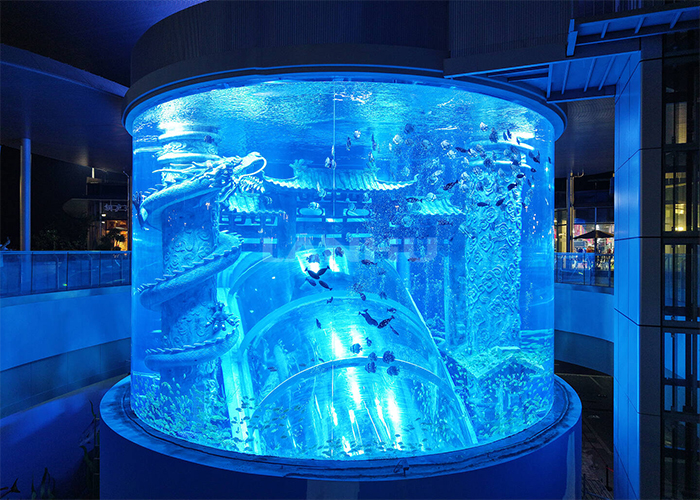
The aquarium has also developed into an actively operated attraction
Recent Chinese media reports describe sharks, rays and large schools of marine fish within the aquarium, along with mermaid performances.
Earlier reports during the freshwater phase described thousands of fish and a large cylindrical tank drawing heavy visitor attention during holiday periods.
This evolution underlines another engineering reality:
A public aquarium is never finished when the acrylic installation is complete.
The structure must support decades of interaction between:
water chemistry;
filtration;
animal life;
maintenance;
cleaning;
lighting;
performance programming;
visitors.
That makes long-term operational stability just as important as initial structural safety.

More news
-

 2026-08-12From Import Dependence to Engineering Confidence: The Rise of China’s Large-Scale Aquarium Acrylic Industry(二)Learn more

-
 2026-08-11Tonglu Service Area Aquarium in China: How Lanhu Acrylic Solved the Engineering Challenges of a Giant Cylinder AquariumLearn more
-
 2026-08-07Alibaba Headquarters Acrylic Diving Pool: Creating a New Marine Experience with Transparent Acrylic TechnologyLearn more